1966
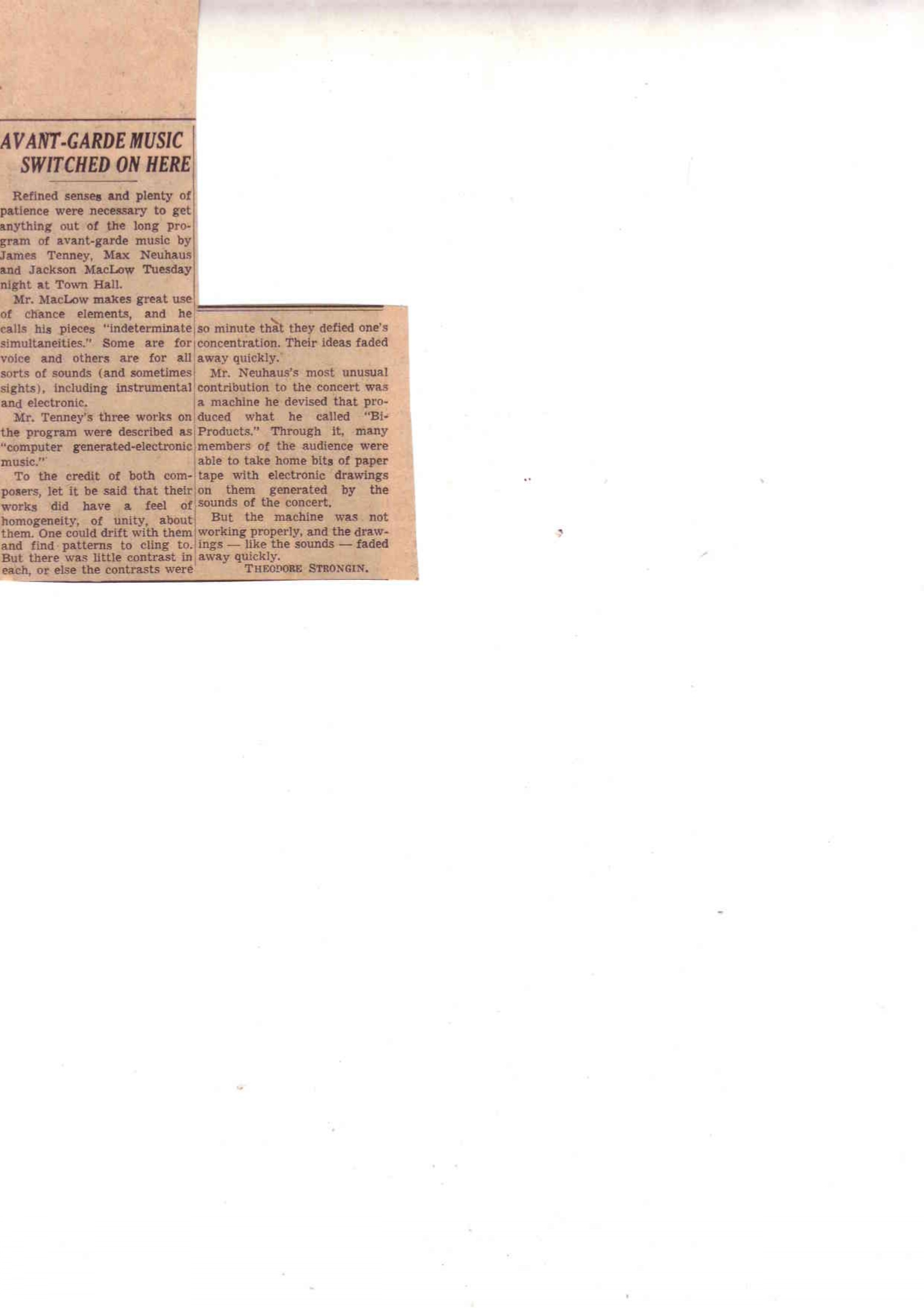
"bits of paper tape w vith electronic drawings on them generated by the sounds of the concert."
Theodore Strongin's review, "Avant-Garde Music Switched on Here," in The New York Times on September 14, 1966, was a critical take on a Town Hall concert of experimental music and poetry. The concert featured works by Jackson MacLow, Max Neuhaus, and James Tenney. Strongin, a music critic often skeptical of the avant-garde, reviewed the event from the perspective of a traditionalist musician
Strongin's criticism of the avant-garde
- Rejection of the traditional concert: The reviewer approached the event as a performance of traditional music and dismissed the artists' unconventional methods. In his view, a concert should focus on musical composition, and the avant-garde's blurring of disciplines into "happenings" was a departure from that standard.
- Focus on process over result: For Strongin, the emphasis on process in works like Neuhaus's Bi-Product and MacLow's electronic poetry came at the expense of musical content and emotional impact. He saw the use of chance operations and conceptual techniques as a substitution for artistic expression.
- Skepticism of electronic music: Strongin viewed electronic music, particularly Tenney's computer-generated work, with suspicion. He echoed concerns, common at the time, that electronic devices would dehumanize music and eliminate the performer.
- Humorous and bewildered tone: The review's tone likely reflected Strongin's bewilderment and critical distance from the avant-garde. He often described performances using sardonic or dismissive language, which highlighted the gap between the artists' intentions and his own expectations.
Reviewing the performances
- Jackson MacLow's electronic poetry: The review described MacLow's reading of his randomized text with electronic accompaniment. Strongin found the work lacking coherence or meaning, suggesting that the use of random procedures failed to produce an intelligible artistic statement.
- Max Neuhaus's Bi-Product: Strongin likely mentioned Neuhaus's conceptual sound installation, where he manufactured and distributed tangible artifacts to the audience during the concert. For a traditional music critic, this multimedia approach, which treated sound as a physical object, was an unusual and puzzling event to evaluate.
- James Tenney's electronic music: The review focused on Tenney's computer-generated compositions. Strongin would have contrasted the mechanical nature of the electronic sounds with what he considered "authentic" music, which is created by human performers.
Context of the review
Strongin's review offers important insight into the reception of avant-garde art by the cultural establishment in the mid-1960s. His perspective was typical of a mainstream critic facing work that intentionally challenged established norms and traditions. In retrospect, the review helps document the experimental climate of the era and the challenges artists faced in communicating their goals to a public accustomed to conventional artistic formats.