1978
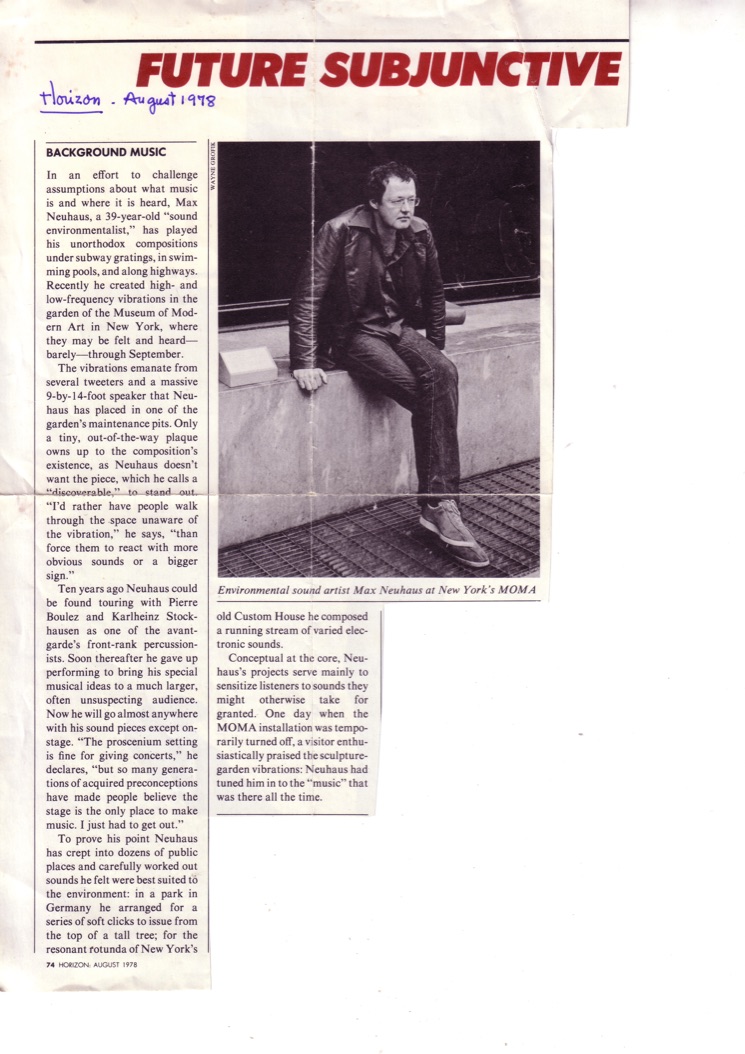
In the August 1978 issue of Horizon, the article "Background Music" (appearing in the "Future Subjunctive" section) examines Max Neuhaus at the peak of his transition from experimental performer to an architect of public sonic space.
The article contrasts Neuhaus's work with commercial "background music" like Muzak. While Muzak seeks to fade into the subconscious to increase productivity, Neuhaus’s work is described as redefining the conscious experience of a space through nearly invisible, continuous tones.
Published one year after the permanent installation of Times Square (1977), the piece highlights how his "invisible sculpture" on the pedestrian island functions as a permanent fixture of the city, rather than a temporary performance MTA
By placing Neuhaus in this specific section, Horizon framed his "sound installations" as a template for future urban design, where sound is treated as a fundamental building material alongside steel and glass.
The article explores Neuhaus's philosophy that sound should not be used to convey "data" or "stories," but to create a physical sense of place, an idea later expanded upon by Brandon LaBelle in Acoustic Territories.