1974
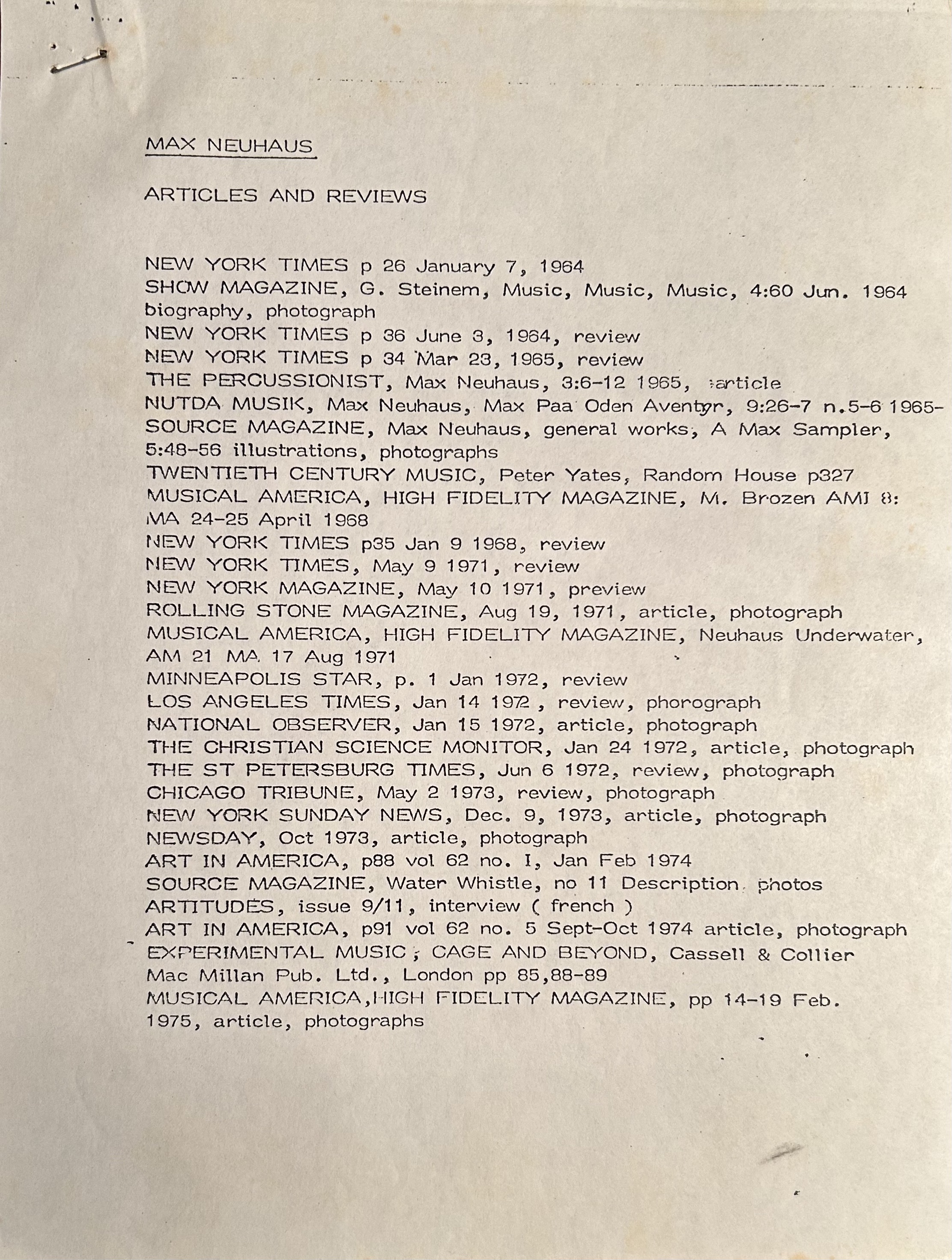
"Experimental Music: Cage and Beyond" by Michael Nyman is a foundational text that outlines the definition and history of experimental music. First published in 1974, it distinguishes "experimental" music from "avant-garde" music, using John Cage as the central dividing line. Michael Nyman highlights Max Neuhaus as a pivotal figure who moved music out of traditional concert halls and into public spaces. Nyman discusses how Neuhaus stopped performing as a virtuoso percussionist to focus on permanent and temporary sound installations. The book covers Neuhaus's early work with environmental sound, particularly his Listen pieces (1966–1968), where he took audiences on silent walking tours to focus on existing city noises. Nyman explores how Neuhaus used electronic sound networks (like his radio transit pieces) to challenge how people perceive space, time, and sound in their everyday environments. Nyman argues that avant-garde music (like Boulez or Stockhausen) still controls the musical outcome. Experimental music (like Cage) focuses on process and allows the outcome to be unpredictable. The book examines how experimental composers stopped using linear time structures, treating time instead as an open space for sounds to exist. Nyman, who actually coined the term "minimalism" in music, uses this text to show how Cage's concepts evolved into the repetitive, process-driven music of Philip Glass, Steve Reich, and Terry Riley.
https://faculty.hampshire.edu/ccox/Cox.Sound%20Art%20in%20America.Cage%20and%20Beyond.pdf