1978
MOMA (Untitled) by Max Neuhaus. Abby Aldrich Sculpture Garden, Museum of Modern Art New York City. Extant: Summer, 1978
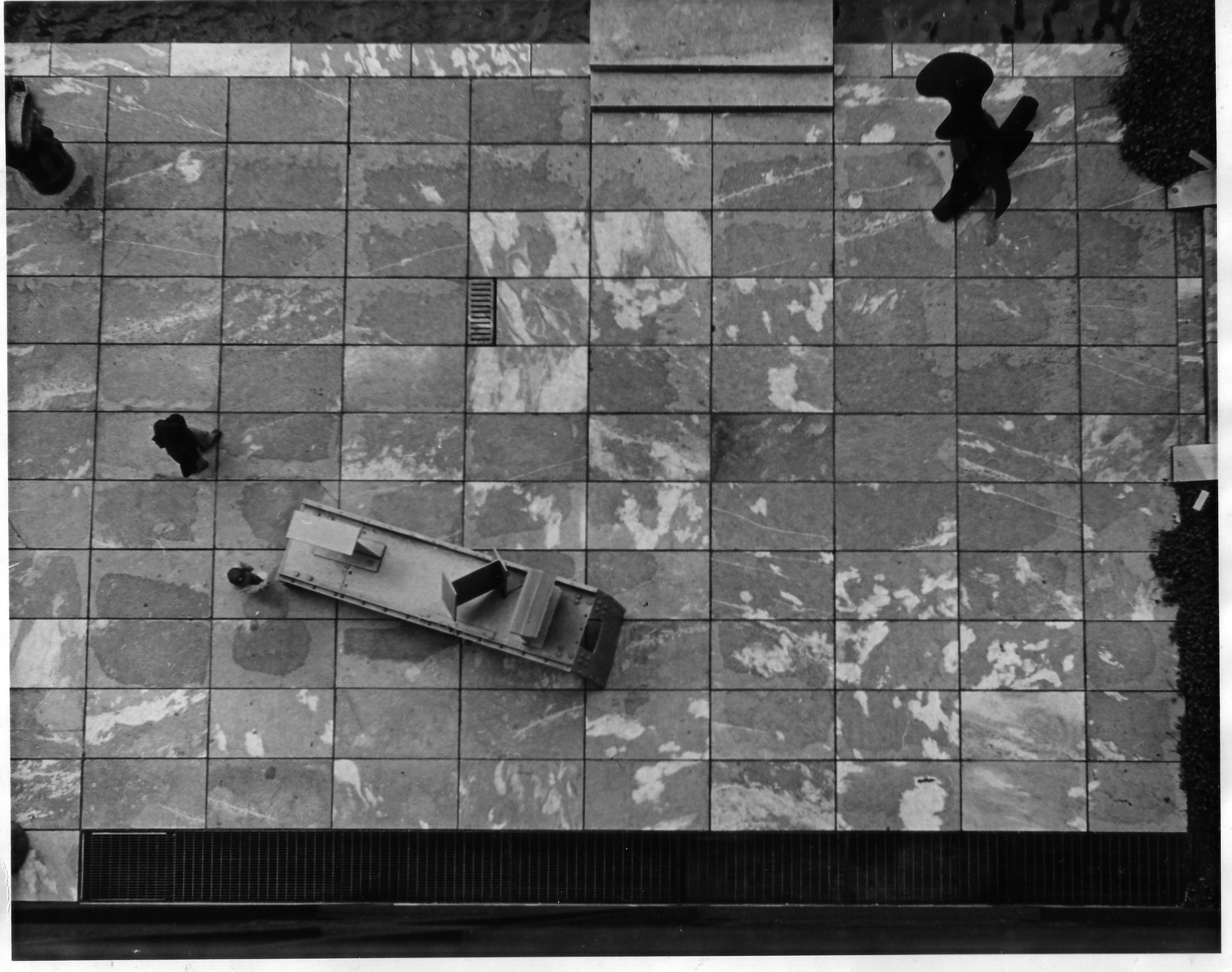
Image: Max Neuhaus, MoMa post card by Max Neuhaus, view of site, 1976
____
Sound Work location: Abby Aldrich Sculpture Garden, Museum of Modern Art, Dimensions: 60 x 20 meters
* * *
While Max Neuhaus’s work on the inaudible began to develop in the early 1960s3, it seems to have gained focus with an exhibition in the form of a sound installa- tion presented by the artist at MoMA between 8 June and 5 September 1978, as part of the Elaine Danheis- ser Projects Series dedicated to emerging artists. For this installation, Neuhaus took over the Abby Aldrich Rockefeller sculpture garden, and, more specifically, the ventilation pipe running along MoMA’s eastern façade. His intervention consisted in modifying the shape of the duct’s mouth, “by adding a concrete pan- el above a slanted side of the chamber, and [adding] four acoustic drivers to the end where they met. It formed a huge loudspeaker with a mouth open- ing of three meters.” Like some institutional critique, Neuhaus acted on the architecture of the site itself, in this instance its infrastructure, making his installation invisible to the public, because hidden behind the ventilation grid. However, the dimensions of the speaker were also significant:
“Contrary to common sense the size of a horn does not determine its loudness, it determines its frequency limits; the bigger it is the lower it can go. The size of this horn allowed me to generate pitches which were below where we have a sense of pitch, subsonic frequencies.”
In short, the work exhibited in the MoMA garden was both invisible and inaudible, the apparatus itself being rendered inaccessible to the public. What kind of ex- perience was it therefore able to suggest? The mu- seum press release did not mention it at all, seeming to avoid the subject.
To find some kind of answer, we have to refer to a later interview with the artist by critic and curator Ulrich Loock, published on the occasion of an exhibition in Turin in 1990. Regarding his MoMA piece Neuhaus explained: “[...] the sound itself was inaudible; what was audible was its effect on other sounds. It was a terrain of an inaudible sound which modified all the ex- isting audible sounds.”6 Certainly, the work’s apparatus was invisible and inaudible, but it produced an effect on its propagation environment. It acted discreetly on the other, fully audible, sounds at the site, altering per- ception of them.
Excerpt from: Bibliography / Texts by others / 2020 - Matthieu Saladin, The Inaudible as an Effect: Tactics of Sound Erasure in Max Neuhaus.
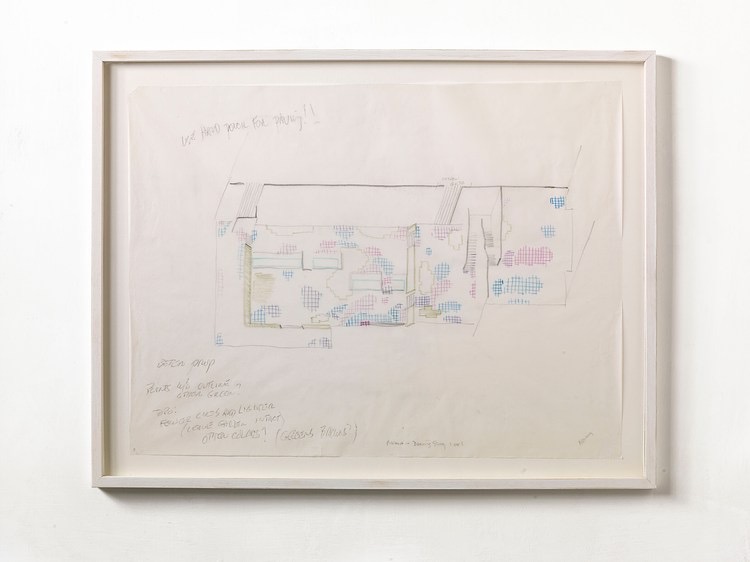
Image: Max Neuhaus Drawing Study
Collection Max Neuhaus Estate.
* * *
With this work for MoMA, I knew from the beginning that I had a way to make very low sounds.
There was a ventilation chamber beside the building, and I saw that it could be turned into a subsonic loudspeaker.
I built it and started tuning. I just took it down, down and down. It could go down to ten cycles per second; we stop hearing sound as sound at about twenty-five, so this is a full octave and a half below where we stop hearing sound. It was the opposite end of aural perception than the work in the "Rooms" exhibition at PS1 – the lower threshold.
I began trying textures, high and medium, but with this incredible bottom end. I soon noticed that some of the lows were actually resonances of the whole garden, and then one day I came back and I said, what is all this? I've got it right here, this is it, I'll just use the inaudible part. It was a nice moment, saying to myself, turn it around, turn it over.
Max Neuhaus
MNE-DRAW (Untitled) MoMA Abby Aldrich Sculpture Garden.pdf
Exhibitions / 1979 - Drawings, (solo Show) Max Neuhaus: Sound Installation, organizer, MoMA PS1, 24 Oct 1979 - 17 Nov
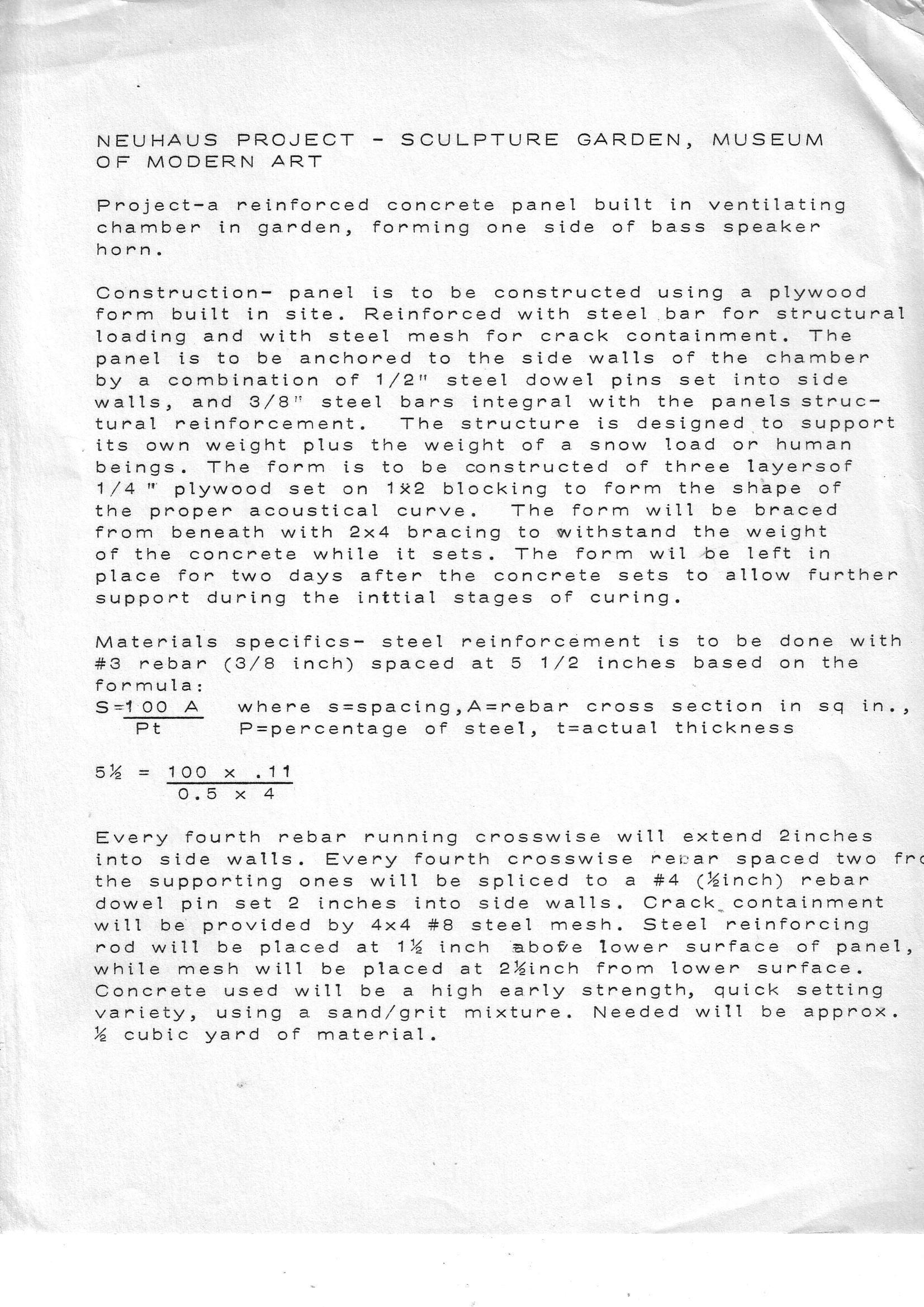
Image: Max Neuhaus Project Sculpture Garden MoMa
Collection Max Neuhaus Estate
Bibliography / Publications / 1978 - MOMA by Max Neuhaus.
Bibliography / Press / 1978 - Max Neuhaus: A New Work (Underground). The Museum of Modern Art, Press Release No. 41. New York.
Bibliography / Press / 1978 - Undergraund Music, MoMa 7 (Summer 1978), p. 7
Bibliography / Press / 1979 - Carter Ratcliff, Max Neuhaus at the MOMA Sculpture Garden and Time Square. Art in America January-February, p. 143
Bibliography / Texts by others / 2011 - Alanna Heiss, On Sound, Space, and the City.