1977
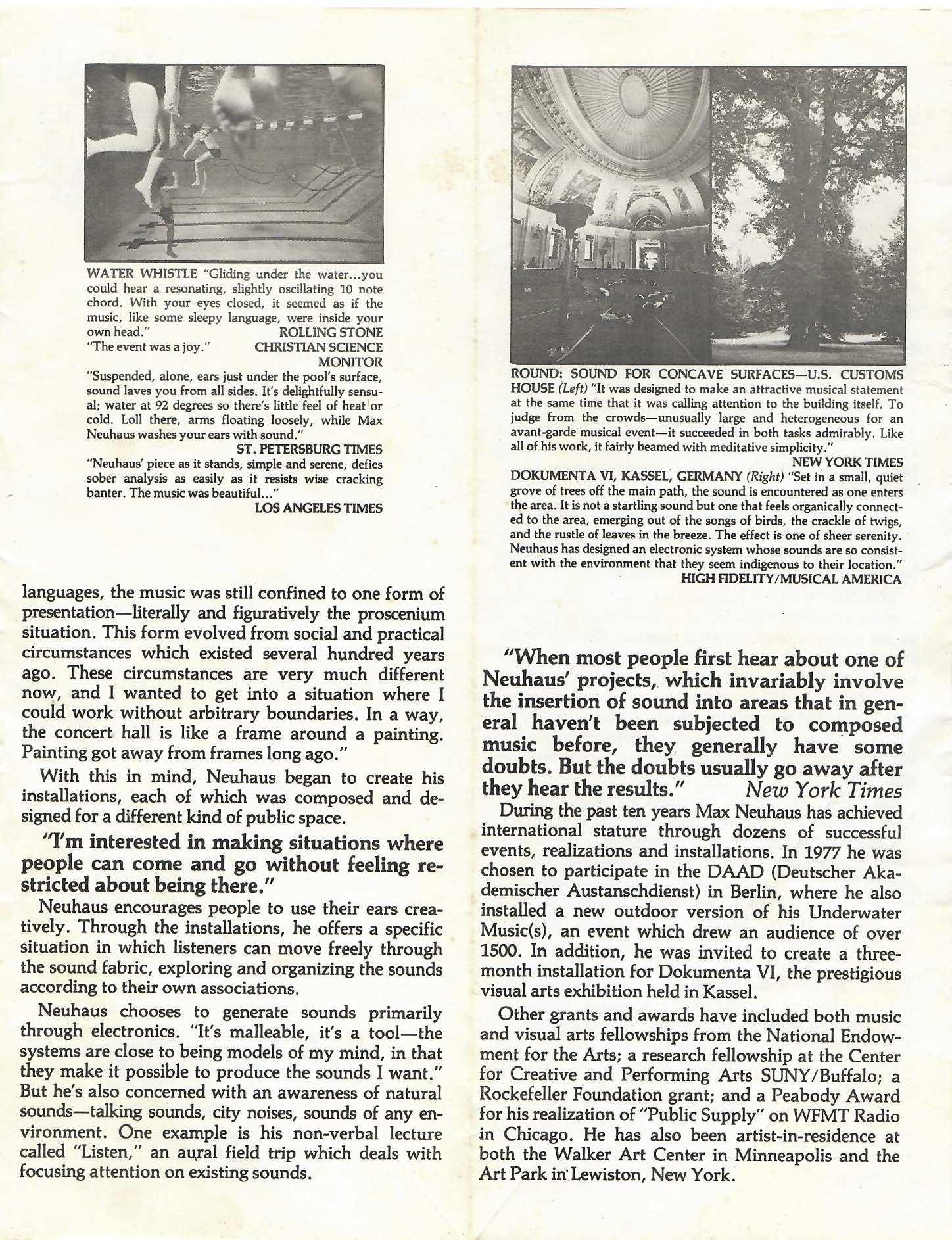
Neuhaus Documenta 6, Poster, 1977
* * *
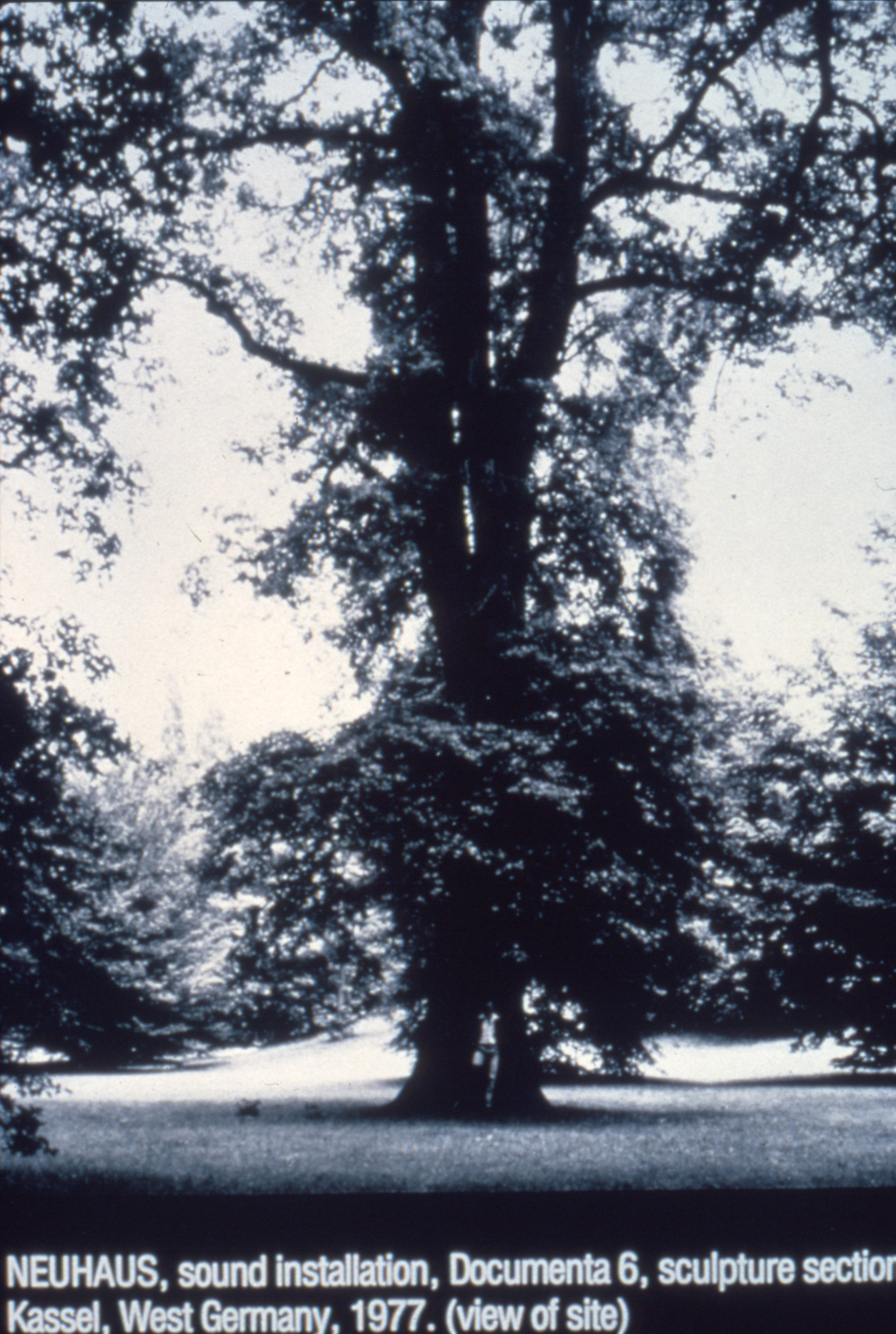
During documenta 6 (1977) at Kassel, Neuhaus implanted his sound installation as a natural part of the environment, as an almost imperceptible, but all the more incisive action upon the wood in Karlsaue Park. Wandering through the sprawling park from the wood and steel paths by George Trakas to the rock piece by Robert Morris, one had to cross a small wood in which one suddenly heard a click-like sound which repeated itself. It seemed so natural that only a few people heard it for what it was, an artificially produced sound projected from speakers hidden in the trees. It represented something which had almost ceased to exist_the sound reminiscent of the quiet snapping of a twig, heard even where there was no one. Art transports our imagination back into a reality which has developed in a different direction. That installation was neither a gesture of politico-ideological denunciation, nor was it an emotional and merely reproductive idealization of nature. Rather, it remains the gesture of an alert artist who expects receptive hearers. It is completely different from the perverse falseness with which hackneyed feelings and phoney cosiness are these days sometimes evoked in postmodern metropolitan hotels (it was in Hiroshima that I once heard 'natural' birdsong coming from a speaker hidden in a plastic birdcage).
Excerpt from: Wulf Herzogenrath, "Bell for St. Cäcilien", 1989
____
A somewhat similar approach with sound dispersion in a non-urban outdoor setting produced a distinctly opposite effect. The untitled contribution for 1977 Documenta VI in Kassel was situated in a clearing around a tree. Hidden in the tree were eight highly directional speakers emitting clicking sounds that seemed to spring from the grass by way of sound reflection. The clicks were reminiscent of “the sounds of stepping on a twig, or a drop of water falling from a leaf.”They might have gone unnoticed as part of the naturally occurring acoustic phenomena, but their persistent bouncing from one spot to another provided an adequate threshold to trigger attentiveness. “The clicks were separated by a second or two of silence, and also had physical space between them. This pointed out, emphasized, directed attention around the clearing in a way that created the sense of this place.
Excerpt from: Dasha Dekleva, Earshot to Here, Oct 2004