2004
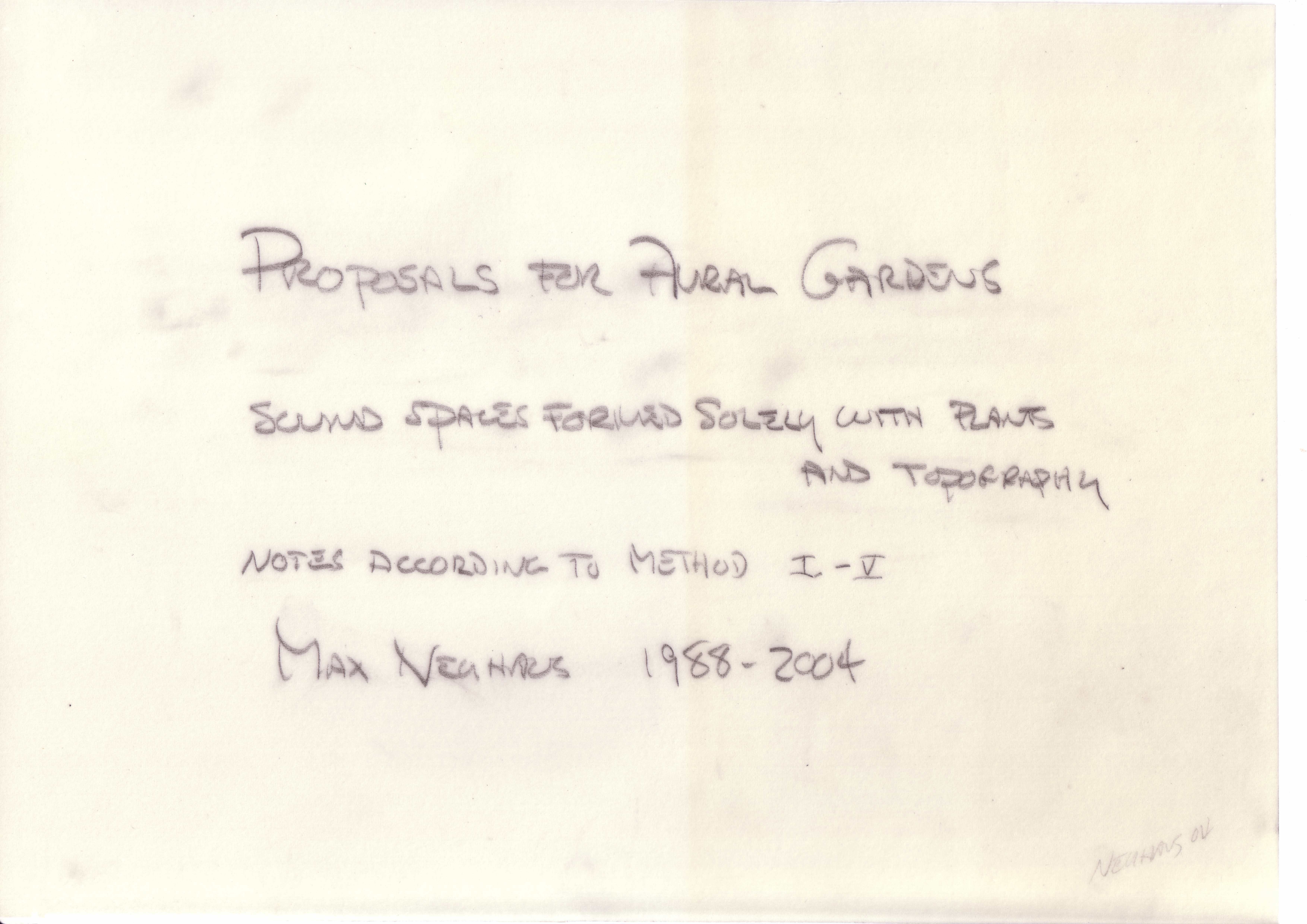
aural-gardens, Sound spaces formed solely with plants and topography, Notes on method I-V, 1988-2004
The drawings were made for an "auditory garden" project. It all began with Max Neuhaus's fascination with the sound quality of a variety of pine trees growing in the Bahamas. If the sound of two needles colliding is inaudible, the sonic texture of hundreds of thousands of needles becomes strikingly rich. It is therefore possible to create a work in situ without any technical devices, by rubbing the leaves of different plant species together.
The modelling of sound in space would be determined by the relief of the terrain, with zones where it would be absorbed by vegetation, and others where the rustle of leaves would reverberate on parabolic surfaces. Working on the curves of the terrain helps to focus and project the sound. The aim is to design the landscape - in a discreet, unspectacular way - and not to add sound elements activated by wind or water, as has long been the practice in garden design.
The artist became a landscape and sound designer. One of these gardens was to be set up near a Rotterdam freeway, to serve as a soundproofing wall.
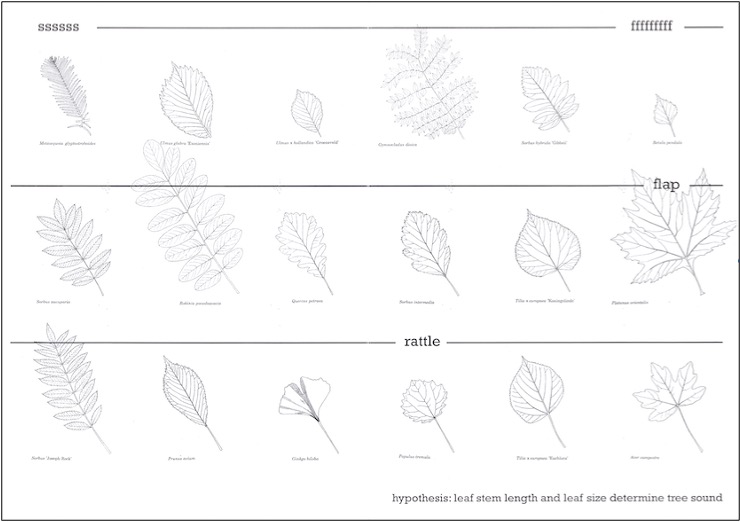
Landscape Vegetation and gradients
____
The Smitsweg site is situated on the southern edge of Dordrecht, near the junction of the N3 and A16 motorways. The starting point was the development of a spatial plan that facilitated the implementation of a diverse housing development program at this location. This resulted in a master plan, which prioritizes sustainability. A flexible subdivision was applied to the housing, based on a peaceful and green living environment. The relationship between the buildings and their surroundings is also extensively addressed in the master plan. By connecting valuable ecological connections, the site-specific environmental characteristics are enhanced. This creates a new neighborhood with a strong identity, seamlessly integrated into its surroundings.