1965
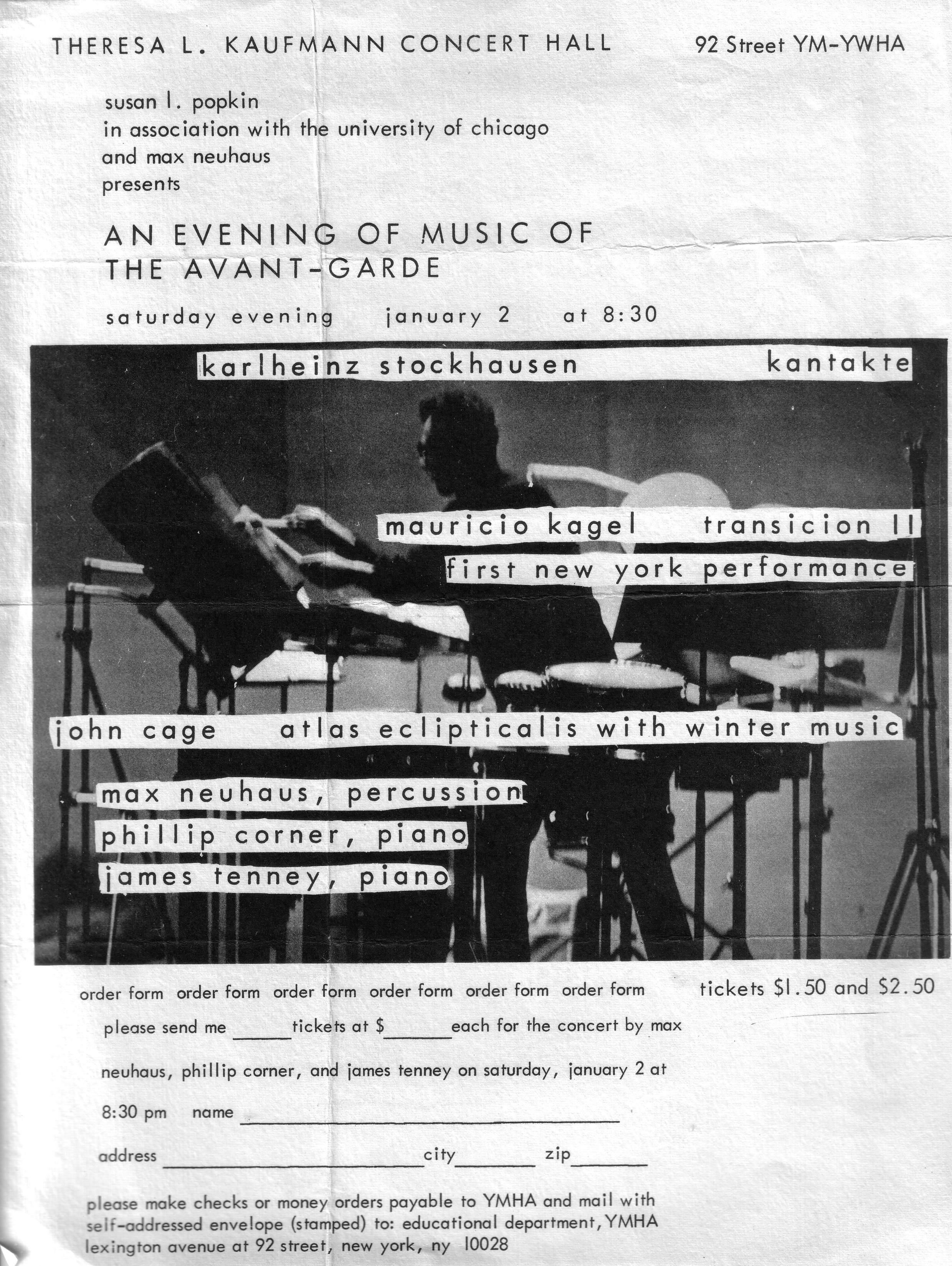

Ensemble: MN (percussion, kettle drums), James Tenney (piano), Philip Corner (piano), Malcolm Goldstein (tape realizations). Work(s): KS, Kontakte; Mauricio Kagel, Transicion II; John Cage, Atlas Eclipticalis with Winter Music. Presented by Susan L. Popkin in association with the University of Chicago. Electronic equipment courtesy of Bell Labs and Columbia University
On January 2, 1965, Max Neuhaus gave a memorable solo percussion recital at Kaufmann Hall at the 92nd Street Y (YM-YWHA) in New York City. Billed as an evening of avant-garde music, this performance immortalized Neuhaus at the height of his touring career, as a master interpreter of international avant-garde percussion. The evening featured a challenging and innovative program that fused live instrumentation with electronics, tape, and historic ensemble collaborations. Program highlights: Karlheinz Stockhausen: Kontakte: A monumental performance of Stockhausen's seminal work for acoustic percussion, live piano, and quadraphonic electronic tape. Fresh from his 1963–1964 tour with Stockhausen, Neuhaus delivered a masterful and physical execution of the complex and rapid-fire electroacoustic dialogue. Mauricio Kagel: Transicion II (New York premiere): This marked the historic New York premiere of Argentine composer Mauricio Kagel's structural masterpiece. The piece requires the percussionist to play not only the standard surfaces of the instruments, but also the edges and supports, using a live recorder operator to capture, loop, and reproduce acoustic triggers in real time. John Cage: Atlas Eclipticalis simultaneously with Winter Music: For this radical, chance-driven performance, Neuhaus did not perform alone. He formed an elite avant-garde trio with pioneering American composers and performers James Tenney and Philip Corner. Together, they superimposed Cage's open-form score, derived from astronomical charts (Atlas Eclipticalis), onto his fragmented, indeterminate piano piece (Winter Music) to create a dense and unpredictable sonic environment. Significance in Neuhaus's Chronology The 92nd Street Y recital occurred during Neuhaus's tenure as artist-in-residence at the University of Chicago (1964–1965). The success of this particular performance, along with his appearances at Carnegie Recital Hall that same year, boosted his international reputation. This momentum propelled him directly into his legendary European tour of 1965–1966, during which he presented fifteen solo recitals in major European capitals before finally abandoning concert performance in 1968 to pioneer the medium of sound installation.