1964
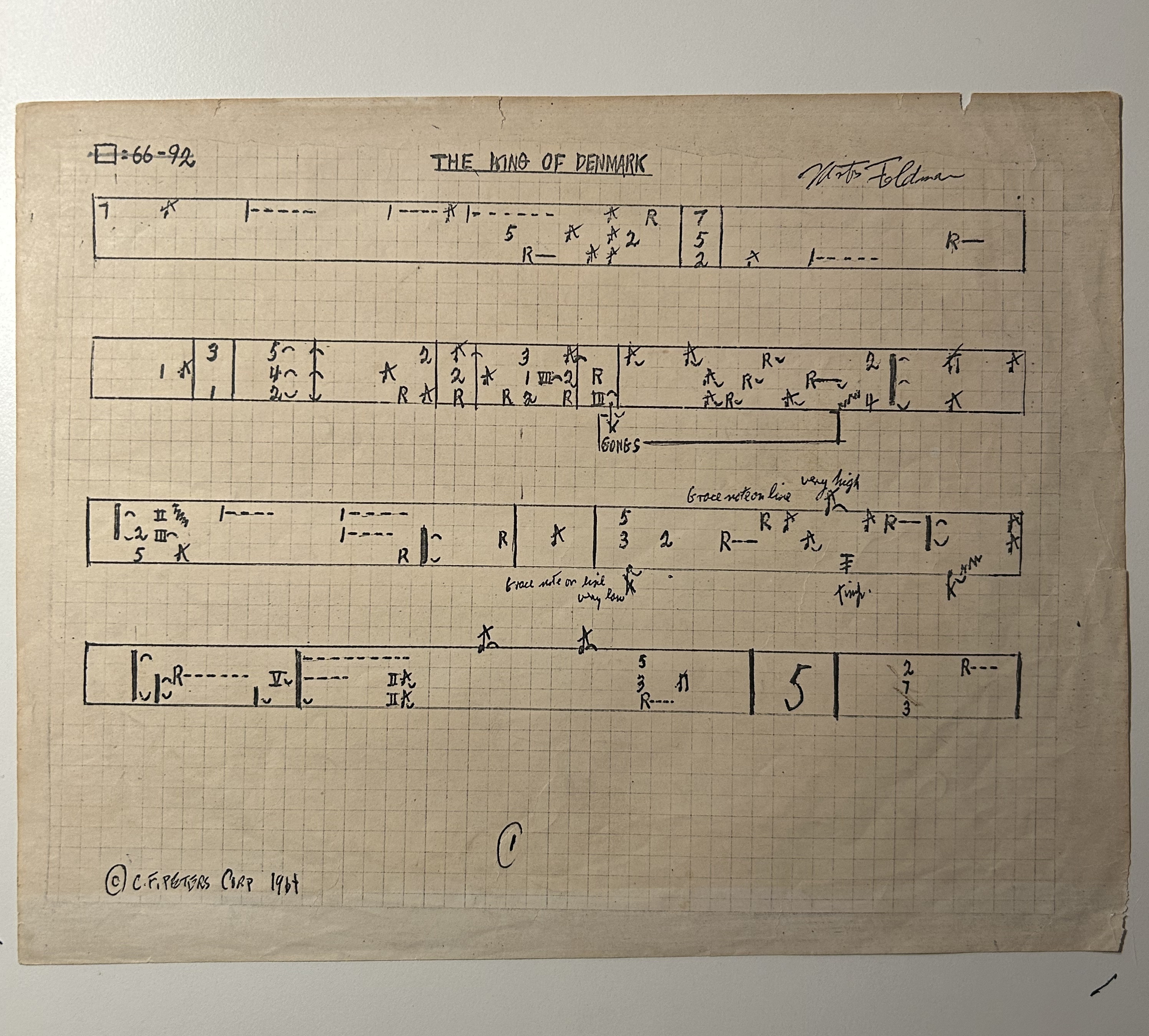
During the Second Annual Avant-Garde Festival organized by Charlotte Moorman, Max Neuhaus performed the world premiere of Morton Feldman’s The King of Denmark (1964) at Judson Hall over a six-night residency.
Feldman composed this work specifically for Max Neuhaus, challenging the traditional "loud" nature of percussion.
The score prohibits the use of mallets or sticks. Neuhaus had to play the entire array of instruments—including bells, tam-tams, and skins—using only his fingers, palms, and arms.
The work is marked by an extremely low volume, hovering at the threshold of audibility. It forces the audience into a state of "extreme listening," a concept that directly foreshadowed Neuhaus’s later sound installations.
Feldman used a grid-based graphic score where the vertical axis represents high, middle, and low pitch registers, while the horizontal axis dictates time, allowing Neuhaus to choose specific instruments within those registers.
In his September 4, 1964, New York Times review, "Music: Avant-Garde Festival Closes," Howard Klein captures the final moments of the 2nd Annual New York Avant-Garde Festival at Judson Hall, noting how performers like Max Neuhaus solidified their status as leading figures in the experimental music scene.
Klein documented Neuhaus's role as a premiere interpreter of percussion and electronic works. During this period, Neuhaus was performing complex, indeterminate scores by composers like Morton Feldman and John Cage, often utilizing his own technical innovations like controlled feedback.
The review highlights the festival's shift from traditional concertizing to multidisciplinary spectacles. Neuhaus performed alongside a roster of radical artists, including Charlotte Moorman, Nam June Paik, and Allen Ginsberg.
A Turning Point: This festival concluded just days before the highly controversial North American premiere of Stockhausen's Originale (September 8–13, 1964), where Neuhaus also played a central role.